

Do you need help resolving your AC compressor problems? Call 352-290-7968 to schedule a service consultation with Fast Air Repair’s repair technicians today.
It’s no secret that Florida boasts some of the hottest temperatures year-round of any state in the US. Maintaining a healthy HVAC system is crucial to a healthy indoor environment in your Florida home. Homes without working AC or that consistently experience issues with HVAC functioning can be far less comfortable.
Your HVAC unit can face many problems. However, AC compressor problems are the worst and some of the hardest to resolve. Understanding the signs of AC compressor problems is crucial so you can immediately call professionals once you suspect an issue.
Whenever your home experiences HVAC breakdowns, call the best Inverness air conditioning service to fix your unit. With years of experience serving homes and commercial properties in Inverness, Dunnellon, and the surrounding areas, our repair technicians can quickly restore your HVAC system to optimal functioning.
What Is an AC Compressor?
Many homeowners don’t know the function of an AC compressor, but cool air circulating throughout their homes is only possible with a working AC compressor.
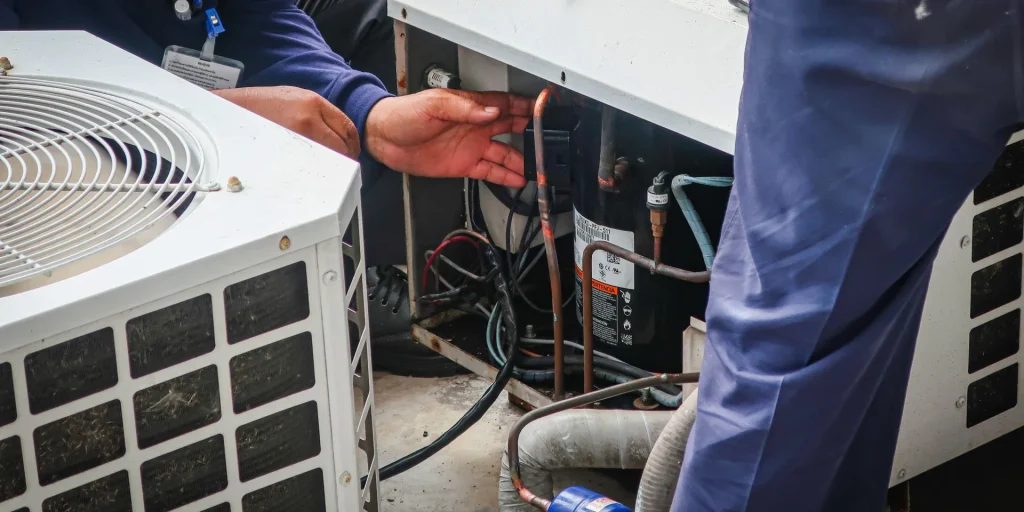
Your AC compressor contains the components responsible for cooling your system. Your air conditioning unit cools your home by recycling air throughout it and infusing it with a chemical called refrigerant. This chemical cools down warm air and primes it to control your home’s interior temperature precisely.
While cooling warm air with refrigerant might seem simple, complex mechanisms in the AC compressor transition this chemical from a liquid to a gas state through various processes to prepare it for its ultimate cooling function. Multiple components within your AC compressor, including the condenser, evaporator coil, and refrigerant lines, perform the complex process of turning refrigerant liquid into a gas and then back into a liquid to cool warm air.
The complex mechanisms within your AC compressor might break down over time. Problems with any of these components will inhibit compressor and HVAC functioning. For example, since the condenser coil returns the refrigerant to a liquid state twice during compressor cycles, condenser coil issues will stop cool air from flowing through your HVAC system.
7 Symptoms of AC Compressor Problems
Now that you understand the importance of your AC compressor, it’s equally essential to recognize the signs indicating there’s a problem. These seven situations are the common signs of AC compressor problems.
Strange Noises
Problems with your compressor unit might manifest in the interior parts of your home’s HVAC system. Over time, wear and tear in these parts could cause issues with your compressor unit. In this case, you may notice strange noises when your HVAC system operates.
Strange noises are never a good sign for your HVAC system. If you notice any sounds like whizzing, buzzing, or rattling beyond typical operational sound, ensure that you call professionals from Fast Air Repair.
AC Blowing Warm Air
It’s normal for warm air to come from your vents for the first few seconds after turning on your air conditioning unit. However, if warm air persists for more than a few minutes, there could be a problem with your AC compressor.
The mechanisms within AC compressors cool the air flowing through your vents. Problems with any of these components will eliminate your unit’s cooling function. In this case, call professionals to inspect your evaporator and condenser coils.
Circuit Breaker Issues
Circuit breakers protect your home from high voltage exposure that could become a fire hazard. During HVAC use, a circuit will trip if the system is overworking beyond a point where the voltage becomes dangerous for your home.
Tripping breakers might suggest AC compressor problems. If your condenser or evaporator coils are in disrepair or the condenser is functioning less efficiently, it might use too much electricity to operate and trip your breaker. Call professionals if your breakers are hot to the touch, as this could indicate more severe issues.
Inconsistent or Obstructed Airflow
When your HVAC system functions efficiently, cold air should flow consistently and unobstructed throughout your home. If you notice less air coming from your vents or it feels obstructed, this could be a problem with your AC compressor. However, many parts of your HVAC system could block air, so it’s wise to call professionals to perform diagnostics on your system.
Outdoor Unit Overheating
Even the sturdiest outdoor compressor units have some sensitivities that require attention. Placing other objects or landscaping within three feet of any side of your outdoor unit could restrict necessary airflow and cause it to overheat.
An overheated outdoor compressor unit can break down and require expensive replacement. To avoid these unnecessary costs, clear the radius around your outdoor unit.
Refrigerant Leak
Leaking fluids from your outdoor unit indicate that your AC compressor has problems. While the refrigerant liquid in your compressor unit is necessary for cooling, it can also be a health hazard and environmental danger. If you notice leaking fluids from the outdoor unit, call professionals to inspect your AC compressor’s ball bearings and structure.
Increasing Utility Bills
Any issue with your AC compressor will likely decrease the efficiency of your unit and system. Reduced efficiency is one of the leading causes of increasingly expensive utility bills.
If you notice costly energy bills, your AC compressor could be the problem. However, this is an excellent time to call professionals to perform diagnostics because system inefficiency might be due to issues with various parts of your system.
Call Professional Repair Technicians from Fast Air Repair for AC Compressor Problems
For more information about resolving AC compressor problems or answers to “Is it bad to keep turning your AC on and off?” call 352-290-7968 and schedule a service consultation with Fast Air Repair’s repair technicians!