



Weeki Wachee sits where the Weeki Wachee River emerges from one of Florida’s most productive spring systems and begins its journey to the Gulf, a community defined entirely by the water that surrounds and underlies it. The springs here discharge tens of millions of gallons daily, and that continuous water output keeps the local air in a state of near-constant humidity that distinguishes Weeki Wachee from nearly every inland community in Hernando County. Homes along the river corridor and in the neighborhoods surrounding the spring system live in a moisture environment that is closer to a coastal estuary than a typical inland Florida town.
The residential character of Weeki Wachee is split between older waterfront properties with long family histories and newer residential development further from the river that grew as the area’s natural attractions brought population growth. Both face the same fundamental challenge: heating systems that sit idle in a sustained high-humidity environment for most of the year and are then expected to perform reliably when cold fronts arrive in winter. Fast Air Repair serves Weeki Wachee as part of our Hernando County territory and brings the spring-environment awareness that service calls here require.
Signs your heating system in Weeki Wachee may need attention:
In Weeki Wachee, the spring system’s moisture output is a year-round presence that does not pause between heating seasons. Systems here need more frequent professional attention than equivalent equipment in drier communities, and the cost of that attention is consistently less than the cost of the failures it prevents.
The Weeki Wachee spring system is not a seasonal feature. It runs at full output year-round, discharging water at a constant temperature of around 74 degrees and maintaining evaporation rates in the surrounding area that keep ambient humidity elevated regardless of what the calendar says. For HVAC systems that spend most of the year inactive in this environment, the effects accumulate in ways that are specific to spring-adjacent locations and that differ meaningfully from what happens to equipment in other parts of Hernando County.
These failure modes are not hypothetical risks in Weeki Wachee. They are what our technicians consistently encounter when they work in the river and spring corridor neighborhoods here.
Fast Air Repair brings spring-environment diagnostic preparation to every furnace call in Weeki Wachee. The moisture conditions here are specific enough that a technician who approaches the call with standard inland assumptions will miss things that a technician who understands this environment will find immediately. We arrive at every Weeki Wachee call expecting the moisture-driven failure modes that define heating problems in this community.
Our furnace repair services in Weeki Wachee include:
Same-day service is available for urgent calls and our 24-hour emergency line is staffed for after-hours breakdowns throughout Hernando County.
We responded to a call from a homeowner named Paul who lives in the Weeki Wachee Gardens neighborhood near the river. He had noticed his gas furnace was producing noticeably less heat than it had the previous winter, even though the system was starting normally and running without any fault codes or error indicators. He had replaced the filter recently and the airflow seemed adequate, so he was puzzled about where the efficiency loss was coming from.
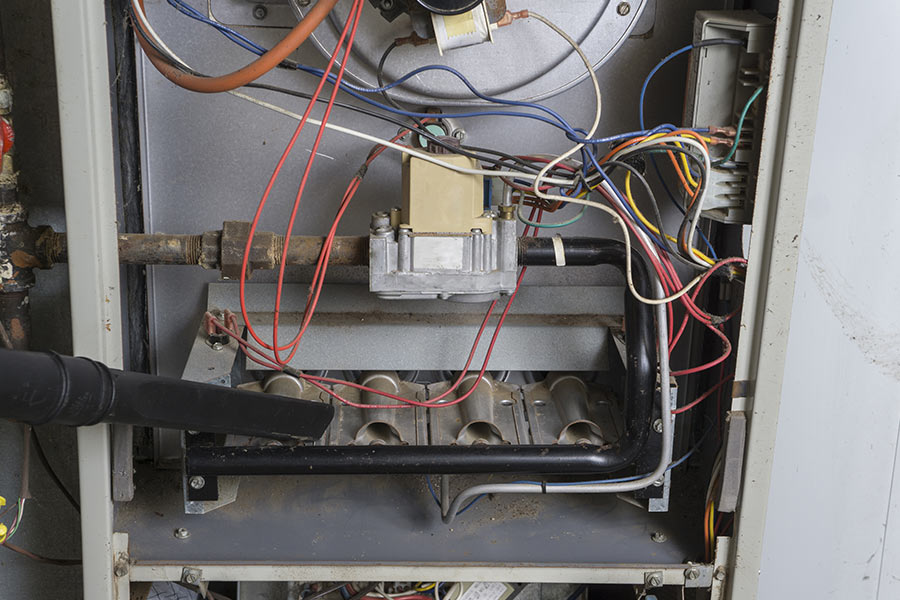
Our technician found significant mineral scale on the furnace’s heat exchanger surfaces, a layer of calcium and magnesium carbonate deposits consistent with extended exposure to the high-mineral aerosol environment near the spring outflow. The scale was acting as an insulating barrier between the combustion gases and the heat exchanger wall, reducing the amount of heat transferred to the supply air with each firing cycle. The furnace was burning fuel normally but delivering progressively less of that combustion energy into the living space as the scale layer had thickened over multiple seasons.
We cleaned the heat exchanger surfaces, ran a combustion analysis before and after to document the efficiency improvement, and checked the condensate system while we had the cabinet open. Paul’s heat output improved measurably within the same evening. He had not realized mineral scale from the local air environment could accumulate inside the furnace the way it accumulates on exterior surfaces around the property. In Weeki Wachee, it absolutely can, and it is one of the service items we check on every call in the spring corridor.
Weeki Wachee is a community where the natural environment is genuinely central to why people live here, and that same environment is central to how we approach every HVAC service call in the area. Fast Air Repair has earned its standing in Hernando County by understanding the specific ways that Florida’s spring systems affect home mechanical equipment, and by treating that understanding as an asset we bring to every call rather than background noise we work around.
Here is what every Weeki Wachee service call delivers:
The Weeki Wachee spring system is one of Florida’s natural treasures. The homes near it deserve HVAC service from a company that understands what living next to it actually means for the equipment inside those homes.
Weeki Wachee homeowners often ask questions that reflect the specific influence of the spring system on their properties. Here are the ones we hear most often before a furnace service call in this community.
Yes. The Weeki Wachee spring system produces a high-mineral aerosol in the surrounding air from constant evaporation off the spring surface. That aerosol is drawn into furnace cabinets and combustion air intakes during operation, depositing mineral scale on heat exchanger surfaces over time. The effect is most pronounced on properties closest to the spring outflow but is measurable throughout the river corridor neighborhood.
Filter maintenance prevents debris from entering the system but does not address the biological growth conditions on the evaporator coil itself. In Weeki Wachee’s sustained humidity environment, mold colonizes the damp coil surface during dormant periods regardless of filter condition. Professional coil cleaning removes the existing growth, and addressing the underlying humidity conditions in the home reduces the rate of recurrence.
High-efficiency furnaces produce condensate water as part of normal operation, and the volume increases as ambient humidity rises or as outdoor temperatures drop and the system runs longer cycles. In Weeki Wachee’s humidity environment, condensate volume during sustained cold-weather operation can exceed what the original drain system was sized for, causing backup and float switch shutdowns. Drain line capacity is worth checking if the system has started shutting off during extended cold spells.
The Weeki Wachee spring outflow produces a slightly acidic aerosol from dissolved carbon dioxide in the spring water. On exterior metal surfaces including furnace flue pipes, this aerosol is mildly corrosive in addition to being highly humid, similar in effect to the salt aerosol in coastal environments. Flue pipes in spring-adjacent properties show external corrosion patterns at joints and seams that develop faster than in standard inland humidity environments.
Annual service is the baseline for any residential furnace, and properties in the Weeki Wachee spring corridor benefit from treating that annual visit as a moisture and biological inspection as much as a mechanical tune-up. Coil cleaning, condensate system check, heat exchanger surface evaluation, and flue condition inspection are all more important here than in drier inland communities. The cost of consistent annual service is substantially less than the cost of the failures it prevents in this environment.